

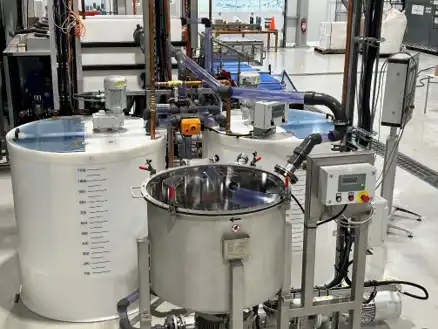
Innofibre’s pilot platform enables companies to test natural fibers, produce nonwoven structures without chemical binders, and validate applications prior to scale-up to industrial production.
Innofibre Harnesses Wetlaid Nonwoven Technology for Cellulosic Fibers
Pilot Equipment at a Glance
Technology: Wetlaid nonwoven formation
Scale: Pre-industrial pilot scale
Raw materials: Natural and cellulosic fibers
Target applications: Hygiene, filtration, batteries, horticulture, geotextiles, and construction
Innofibre operates a complete pilot line for wetlaid nonwoven production designed for the development of bio-based fibrous materials.
The platform can process natural and cellulosic fibers into nonwoven webs, allowing their properties to be evaluated before considering scale-up to industrial production.
For forest products companies and fiber processors, the equipment provides a pathway to diversify beyond traditional pulp and paper markets. It can be used to explore higher-value applications including absorbent products, filtration media, insulation materials, and structural materials.
How the Pilot Line Works
The wetlaid process incorporates several principles from papermaking.
The fibers are first dispersed in pulpers and then suspended in water. The resulting fiber suspension is formed into a web to produce a uniform fibrous structure.
The line also includes a hydroentanglement system that uses water jets at pressures of up to 100 bar. These high-pressure jets mechanically entangle the fibers, thereby providing strength and cohesion to the material.
Depending on the fibers used and the performance requirements, this approach can reduce or eliminate the need for chemical binders.
What Companies Can Test
The platform enables companies to evaluate different blends of natural and cellulosic fibers, as well as their behavior during web formation, consolidation, and drying.
Trials can focus on:
- fiber composition and blending ratios;
- web formation and uniformity;
- mechanical strength;
- liquid absorbency and retention;
- porosity and permeability;
- thickness, density, and bulk;
- the feasibility of producing the material without chemical binders.
The objective is to reduce technical uncertainty before investing in industrial equipment or proceeding with larger-scale production trials.
The Role of Hydroentanglement
Hydroentanglement is a key stage in the pilot line.
By directing fine, high-pressure water jets onto the web, the system rearranges and mechanically entangles the fibers. This increases the material’s cohesion without requiring thermal bonding or the extensive use of adhesives.
This technology is particularly relevant to products in which softness, absorbency, flexibility, or the integrity of the fibrous structure are important.
It can also support the development of compostable or biodegradable solutions, provided that all fibers and other components used are compatible with these end-of-life objectives.
New Through-Air Drying Capability Planned for Early 2027
Innofibre plans to add a through-air drying system in early 2027.
Rather than pressing the web against a heated surface, this method directs hot air through the fibrous structure. This helps preserve the material’s thickness, bulk, and porosity.
The added capability will be particularly useful for absorbent products, filtration media, and insulation materials, where performance depends on maintaining an open fibrous network.
Four Application Markets
Hygiene and Absorbent Products
The line can be used to develop biodegradable wipes, absorbent layers, and other hygiene products based on cellulosic fibers.
In this market, key performance requirements include softness, wet strength, absorbency, and end-of-life considerations.
Filtration and Technical Applications
Wetlaid structures can be used to manufacture filtration media and technical substrates with controlled porosity.
The platform allows fiber composition and web density to be adjusted according to the particles to be retained, the required flow rates, and the mechanical constraints of the application.
Battery Separators
Cellulosic nonwovens can also be evaluated as components for battery separators.
These applications require tight control of thickness, porosity, dimensional stability, and material uniformity.
The pilot line makes it possible to measure and optimize these parameters before committing to more costly scale-up work.
Horticulture, Geotextiles, and Construction
The process can also support the development of horticultural mulches, bio-based geotextiles, insulation materials, and specialized fibrous structures.
These markets offer opportunities to create higher-value products from forest-based fibers that are not always suited to conventional papermaking applications.
Why This Platform Matters to the Pulp and Paper Industry
The Wetlaid line enables pulp, paper, and fiber-based material producers to test new formulations, convert cellulosic fibers into nonwovens, and validate process parameters before moving to industrial-scale production.
It also provides a diversification pathway into higher-value markets, including hygiene products, filtration media, battery separators, geotextiles, and bio-based insulation materials.
About Innofibre
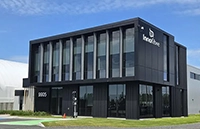
Innofibre – Cellulosic Products Innovation Center supports companies in the development, evaluation, and scale-up of processes and products derived from forest biomass and cellulosic fibers. Its pilot facilities enable testing under pre-industrial conditions, characterization of the resulting materials, and reduction of technical risks before transfer to commercial production.
Our team will be pleased to respond promptly and help support your project.
3351 Boulevard des Forges
P.O. Box 97
Trois-Rivières, Quebec G9A 5E6
819-376-5075