


Packaging automation is moving deeper into eCommerce fulfillment, changing not only how parcels are packed but also how corrugated packaging is designed, produced and integrated into increasingly automated warehouse operations.
One of the most visible developments is the growth of right-sized packaging, in which a shipping box is made or configured around the dimensions of an individual order instead of being selected from a fixed range of standard sizes. The approach is intended to reduce empty space and void fill, and can lower corrugated use and shipping volume depending on package design and order profile.
A growing range of equipment suppliers and packaging producers are developing systems around this model. CMC Packaging Automation offers its Supervertical Box, a compact vertical system designed to produce right-sized corrugated boxes for single- and multi-item orders. The equipment processes E- and B-flute fanfold corrugated material, and CMC lists a maximum mechanical speed of 400 boxes per hour.
Packsize is targeting higher-volume applications with its fully automated X6 system. Its current specifications indicate production of up to 1,300 boxes and trays per hour, with integration capabilities for autonomous mobile robots, automated guided vehicles and automated storage and retrieval systems.
The market is also consolidating. On June 30, Packsize announced an agreement to acquire the packaging business of Italy-based Panotec, which manufactures automated right-sized packaging equipment. Packsize said the combination would expand its machine portfolio and installed customer base across more than 50 countries. The transaction remains subject to customary closing conditions, including applicable regulatory approvals and required union consultations.
Corrugated packaging producers are extending their role beyond supplying board and boxes. Smurfit Westrock offers a portfolio of right-size packaging equipment that includes its Opera and Operetta systems. The company says Opera can produce up to 13 boxes per minute and Operetta up to 15, depending on box size. Both use corrugated board to produce right-sized boxes based on individual order requirements.
Automation is also reaching other stages of the packing process. Under a multi-year agreement announced in 2025, Walmart is deploying Ranpak AutoFill systems across its five Next Generation Fulfillment Centers. The technology uses machine vision and artificial intelligence to assess package contents and determine the amount of paper void fill required, bringing automated decision-making directly into the packing process.
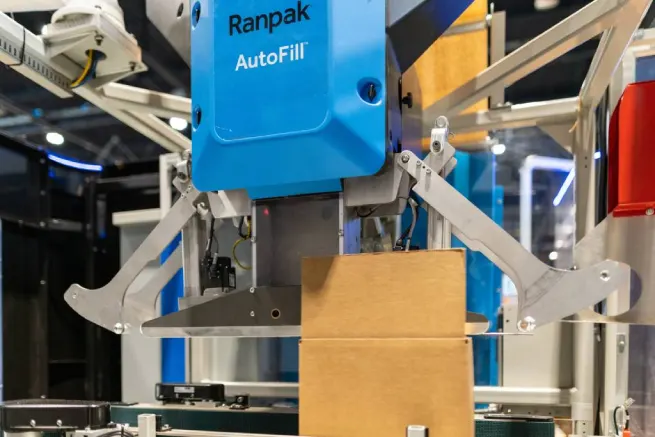 Ranpak’s AutoFill system automates paper void filling and box closing, illustrating how automation is extending beyond box production into the packing process. Photo: Ranpak.
Mondi has highlighted the same broader shift, arguing that packaging is becoming more closely integrated with automated picking, sorting and fulfillment systems. Its eComPack system is designed to automate packing operations using the company’s corrugated EnvelopeMailer and illustrates how packaging suppliers are increasingly linking materials with equipment and fulfillment processes.
Consumer expectations may provide another incentive to address oversized packaging. Mondi’s 2026 eCommerce Trend Report found that 41% of respondents had noticed retailers using more right-sized packaging, while 72% said they would avoid retailers using oversized packaging. The research drew on 6,000 online shoppers in Germany, Poland, France, Sweden, the United Kingdom and Türkiye, meaning the findings reflect those markets rather than North American consumers.
Regulation adds another driver
In Europe, regulation is creating an additional incentive to reduce excess packaging. Under the EU Packaging and Packaging Waste Regulation, companies filling grouped, transport or eCommerce packaging will have to ensure that empty space does not exceed 50% by January 1, 2030, or three years after the relevant implementing rules enter into force, whichever is later.
The calculation includes space occupied by void-fill materials such as paper cuttings, air cushions, bubble wrap and foam, which the regulation treats as empty space. The European Commission is required to establish the methodology for calculating the ratio through implementing acts by February 12, 2028.
For corrugated packaging producers, the trend points toward a closer relationship between board performance, box design and automation equipment. Corrugated packaging increasingly has to move consistently through automated forming, sizing, closing, labeling and handling systems while accommodating a highly variable mix of eCommerce orders.
Rather than replacing corrugated packaging, automation is changing the conditions under which it is produced and used. As fulfillment centers seek greater throughput while reducing unused package volume and unnecessary material, the ability to produce the right box at the right point in the process is becoming an increasingly important part of eCommerce packaging strategy.