


Europe’s current climate policy architecture has inherited a reflex that relies overwhelmingly on the heavy stick. Sanctions, tightening caps, rising compliance costs, and—at times—an undertone of degrowth ideology dominate the debate. This approach might create the illusion of control, but it was never the DNA of the European Union.
This matters now. In the coming months, Europe will redefine its industrial and climate framework through the revision of the EU ETS, the upcoming Bioeconomy Strategy and the Biotech Act II. The question is not whether Europe decarbonises, but whether it does so by strengthening its industrial base or weakening it.
The EU was founded to align economic integration with stability, prosperity, and shared progress. Climate policy should reflect that same spirit. Instead, today’s framework risks producing outcomes that are economically stagnant and socially corrosive. In inflation-corrected terms, the ETS sectors have stagnated over the past decades, and many are already experiencing de facto degrowth—with devastating consequences for industrial investment, skilled employment, and regional cohesion.
History offers a useful metaphor. The Persian king Xerxes, awed by the beauty of a tree—more precisely, by its shadow—ordered it adorned with gold and appointed a guard to protect it from storms. We can only imagine the poor guard’s fate if the tree ever faced the wind. This was the same ruler who famously ordered the sea to be whipped when a storm destroyed his bridge at the Hellespont: 300 lashes against nature itself followed by heavy chains thrown in the sea. An equally meaningless attempt to rule complexity through punishment alone.
Europe risks repeating that error. We adorn climate targets with gold, stand guard with sanctions, and whip the market when industry cannot or nature refuses to comply. What we need instead is a system that works with—and through—the forces of the real economy.
Why a Carbon Economy?
Europe does not lack strategies. The Circular Economy and the Bioeconomy are well established, increasingly sophisticated, and already delivering results. But what remains missing is the framework that binds them together: a Carbon Economy.
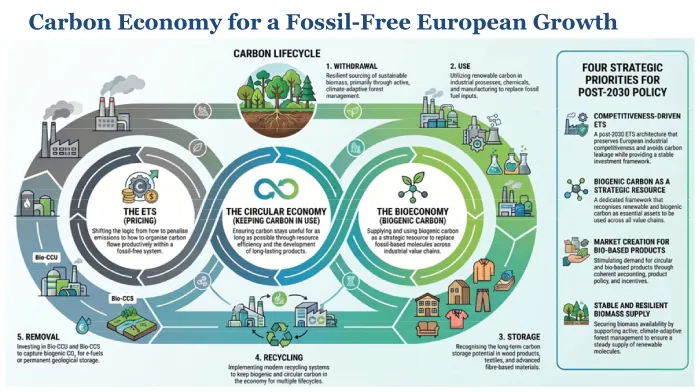
Put simply, a Carbon Economy means managing carbon flows across their full lifecycle—withdrawal, use, storage, recycling and removal—while rewarding the replacement of fossil carbon. It connects three pillars that today remain fragmented: the ETS (pricing), the circular economy (keeping carbon in use), and the bioeconomy (supplying and using biogenic carbon).
Not by adorning the tree with gold. Not by ordering men to stand guard against storms. But by allowing companies to grow with it.
A Carbon Economy would not replace the ETS; it would complete it. It would shift the logic from “how to penalise emissions” to “how to organise carbon flows intelligently and productively in a fossil-free system.” Businesses would still face a firm carbon price, but they would also be allowed to grow their own carrots—by investing in renewable carbon, bio-based products, circular material flows, and carbon removal.
This is where the implementation of the Bioeconomy Strategy, via Biotech Act II becomes critical. It can translate this logic into market reality by creating demand for bio-based and circular carbon through product requirements, carbon accounting and targeted incentives. Without this, Europe risks regulating supply without ever creating markets for the alternatives.
This requires a change in mindset. But it does not require abandoning Europe’s institutional foundations. On the contrary, it requires returning to them.
Sustainable Biomass as the Backbone of a Fossil-Free Economy
At the core of a competitive Carbon Economy lies sustainable and resilient sourcing of biomass in a changing climate. Replacing fossil carbon is not an abstraction—it requires molecules. Forest-based biomass, when sourced through active, climate-adaptive forest management, provides renewable carbon at scale while strengthening land resilience and rural economies.
European experience already shows what works. Active forest management has doubled standing stock in parts of Europe over the last century while maintaining harvesting levels. Yet current policy frameworks risk discouraging precisely this activity through unrealistic LULUCF targets, rigid sink accounting, and fragmented carbon removal rules.
A Carbon Economy would treat renewable carbon as a strategic resource. It would support auditable and scalable certification frameworks for carbon removals, compatible with existing schemes such as FSC and PEFC, and it would reward active land use—including wildfire prevention—as a verifiable ecosystem service. This is not deregulation; it is smarter regulation aligned with science, resilience, and security of supply.
The upcoming Bioeconomy Strategy should build on this by treating biogenic carbon as a strategic resource and ensuring coherence across climate, industrial and product policies.
Circularity, Resource Efficiency, and Long-Lasting Products
A true Carbon Economy also requires that carbon stays useful for as long as possible. Resource efficiency, circularity, and durable products are not secondary add-ons but central pillars.
Here, current accounting rules lag behind industrial reality. The reporting of Harvested Wood Products under LULUCF still relies on overly broad categories and outdated half-life values that fail to capture modern recycling systems and long-lived applications. Paper products can store carbon far longer than the default two years; wood products increasingly remain in use for many decades.
Updating these metrics is not creative accounting, it is accurate accounting. Expanding HWP categories to include textiles, chemicals, and advanced fibre-based materials, and recognising substitution effects as a formal reporting category, even if only as a KPI to start with, would finally make visible the bioeconomy’s contribution to defossilisation.
Equally important, sustainably sourced renewable content should be recognised as a legitimate “circular input,” on par with recycled material. Circularity must describe real material flows, not ideological purity tests.
This also requires fixing the methodological backbone of EU policy. The Product Environmental Footprint must properly account for biogenic carbon cycles, recognise carbon storage and ensure a fair comparison between fossil and bio-based products. Otherwise, it risks discouraging the very solutions it aims to promote.
Strategic Investments in Bio-CCU and Bio-CCS
Finally, a Carbon Economy must invest in managing carbon at the end of the value chain. Europe’s paper industry already produce 100 million tonnes of biogenic CO₂ each year – often in high concentrations ideally suited for capture.
Bio-based CCU and CCS can turn this carbon into e-fuels for aviation and maritime transport, renewable chemicals, or permanently stored material in construction. Yet today, investment is held back by regulatory uncertainty, lack of infrastructure, and unclear treatment under the ETS.
A credible post-2030 architecture should use the ETS as a platform – not a barrier – for carbon removal. Captured and sustainably sourced biogenic carbon must be recognised, surrender obligations avoided where carbon is permanently stored or product-bound, and revenue streams made predictable. Crucially, deployment must remain voluntary, respecting the diversity and symbiosis of industrial installations.
Back to Europe’s Origins
This is not about weakening climate ambition. It is about making it work.
The European Union was never built to punish its way to prosperity. It was built to align markets, innovation, and shared rules so that growth and resilience reinforce each other. A Carbon Economy – designed to complement and accelerate with the Circular Bioeconomy – fits squarely within that tradition.
In the next coming months, the current policy cycle should focus on four priorities:
– a post-2030 ETS that preserves competitiveness, avoids carbon leakage and provides a stable framework for investment
– a framework that recognises renewable and biogenic carbon as a strategic resource and enables its use across value chains
– the creation of markets for circular and bio-based products through coherent product policy, carbon accounting and demand-side measures
– and policies that secure a stable and resilient supply of sustainably sourced biomass, including through support for active and climate-adaptive forest management
Post-2030, the choice is clear. Europe can continue on its path of whipping the sea, tightening rules in the hope that reality will comply. Or it can design a Carbon Economy that rewards investment, mobilises renewable carbon, and allows European industry to deliver climate neutrality without sacrificing competitiveness or social cohesion.
The second path is harder. But it is the one that actually works.
Cepi (the Confederation of European Paper Industries) represents the European pulp and paper industry. Its members include national associations across Europe, representing companies that manufacture pulp, paper and paperboard and play a key role in the continent's circular bioeconomy.