

A University of Maine graduate student is developing wood-based foam that could provide a renewable alternative to the polyurethane insulation commonly used in beverage coolers.
Quazeem Tiamiyu, a master’s student in UMaine’s School of Forest Resources and a graduate research assistant in the Laboratory of Renewable Nanomaterials, designed the material to reduce the health and environmental risks associated with petroleum-based polyurethane.
Before joining the research group led by Mehdi Tajvidi, professor of renewable nanomaterials, Tiamiyu earned his bachelor’s degree from the Federal University of Technology in Minna, Nigeria.
Polyurethane provides effective thermal insulation but is made from nonrenewable resources and degrades slowly. Its raw chemicals can also pose health risks to workers before the material is processed.
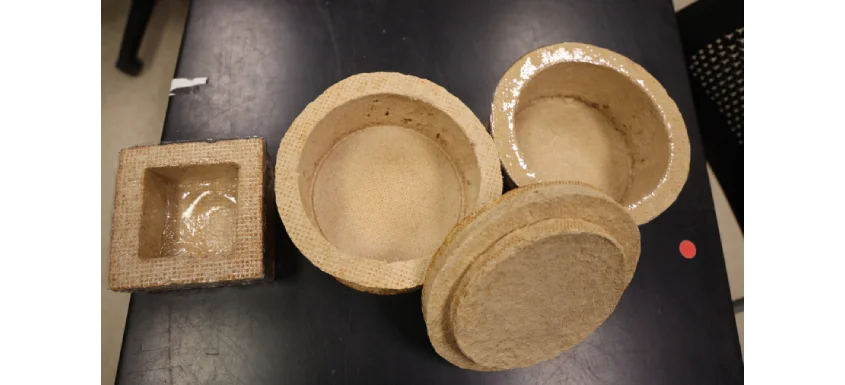
The experimental foam combines cellulose nanofibrils, wood fibre, finely ground wood flour and a surfactant that increases foam volume. Produced by breaking wood pulp into extremely thin strands, cellulose nanofibrils act as both a binder and a stabilizer, creating a strong network within the wood-based materials.
The work is supported by UMaine’s Process Development Center, the only facility in the United States capable of continuously producing cellulose nanofibrils at pilot scale at volumes of up to four tons per day.
 Credit : University of Maine
To produce the insulation, Tiamiyu blends the ingredients into a foam and pours it into moulds shaped like cooler inserts. Water is drained from the moulds, after which the material is dried and enclosed in a protective shell.
Initial tests found that the wood-based foam delivered thermal conductivity results close to those of polyurethane.
“We actually found that we can compete with polyurethane foam,” Tiamiyu said.
Several challenges remain before the material can move toward commercial use. Researchers must improve its mechanical strength and develop an efficient method for encapsulating or installing it in cooler cavities.
Conventional polyurethane can be injected as a liquid directly into a cooler shell, where it expands and remains in place. The wood-based alternative requires wet processing, drying and separate installation, making manufacturing more complex.
Durability is another research priority because crushing or damaging the foam can reduce its insulating ability. Planned ice-retention tests will compare how long the material preserves ice against conventional polyurethane-insulated coolers.
Tiamiyu is also investigating whether the finished foam can be redispersed in water and moulded into new shapes. If successful, the approach could allow manufacturers to receive the material in a transportable form and adapt it to different products.
The project demonstrates how byproducts from Maine’s lumber industry could be converted into renewable insulation materials while reducing dependence on petroleum-based foam.
Founded in 1865, the University of Maine is the state’s flagship public research university and its only Carnegie R1 institution. Based in Orono, UMaine conducts research and provides education and outreach in areas including forestry, advanced materials, manufacturing and environmental sciences.