

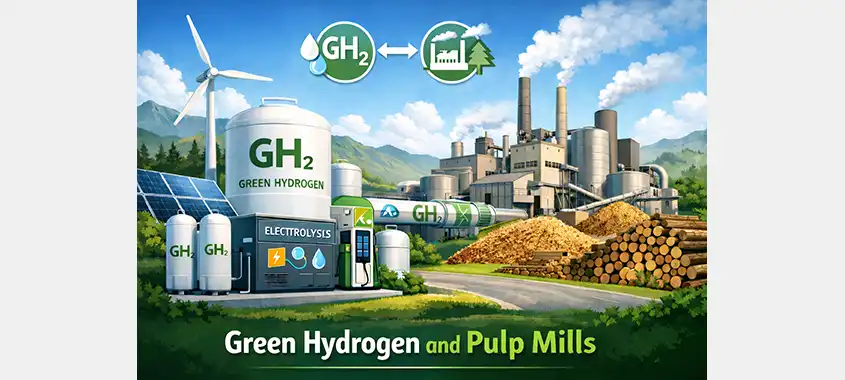
“Green” hydrogen (GH2) will be important in the future because it can play a key role in decarbonizing processes that are difficult to electrify.
It is produced using renewable electricity such as wind, solar, or hydroelectricity to electrolyze water. When burned or used in fuel cells, hydrogen produces only water, making it a very clean energy carrier.
GH2: H2O + electrolysis → H2 +½O2
A few years ago, a classification system was put together describing different methods of producing hydrogen as having different “colours” (hydrogen, of course, is a colourless gas). The traditional method, using natural gas and steam reforming, is dubbed “grey” hydrogen and emits CO2 in the process. Because of the low molecular weight of hydrogen, 1 tonne of grey hydrogen emits a minimum of 5.5 tonnes of CO2 and up to 12 tonnes if fossil fuel is used to produce the steam.
CH4 + 2H2O → CO2 + 4H2
“Blue” hydrogen uses the grey process but adds on carbon capture and storage (CCS) to remove the CO2. A grey hydrogen facility in Alberta is currently being retrofitted to produce 300,000 tonnes of blue hydrogen annually by 2029. As many as 12 colours of hydrogen, i.e., 12 processes to produce hydrogen, have been defined.
Unlike fossil fuels, which have to be mined and theoretically will run out some day, water is available everywhere; 99.9% of the world’s H atoms are found in H2O molecules.
Although as many as 1500 GH2 projects have been announced around the world, only a few are operational so far. Many projects have been abandoned, cancelled or postponed, mostly for economic reasons. The following table summarizes a few GH2 plants operating today. When the green power is an intermittent source (e.g., solar or wind power), installations commonly include large-scale batteries to store energy in order to operate continuously.
| Location | Capacity, MW |
Power source | Planned use |
| Xinjiang, China | 260 | Solar | Industrial use |
| Niagara Falls, NY, USA | 35 | Hydroelectric | Industrial use |
| Puertollano, Spain | 20 | Solar | Ammonia & fertilizer production |
| Szazhlombatta, Hungary | 10 | Purchased certified renewable | Natural gas replacement in refinery |
| Barcelona, Spain | 2.5 | Purchased certified renewable | Hydrogen fuel cells in public transport (buses) |
| Punta Arenas, Chile | 1.2 | Wind | Liquid e-fuels made from H2 + CO2 |
Green Hydrogen at Pulp Mills
Now that we’ve established the background, let’s talk about GH2 and pulp mills. As you can see from the chemical equation at the beginning of the article, the GH2 process also produces four tonnes of oxygen for every tonne of hydrogen. There is a unique opportunity here, since a pulp mill that is using oxygen in its bleach plant can use this oxygen instead of buying it from a gas supplier. The hydrogen can be used to replace some natural gas in the lime kiln, lowering GHG emissions. Using typical current prices, the operating savings for a 10 MW GH2 facility producing 7000 tonnes per year of GH2 can be estimated as:
- Savings in purchased natural gas: C$540k
- Savings in purchased oxygen: C$2.2M
- Reduced federal carbon taxes: C$770k in 2026, rising to $1.19M in 2030
- Possible heat savings
Thus, there is an annual incentive in the neighbourhood of C$4 million to operate a GH2 plant. What are the main risks?
- Capital cost – this will be several million dollars, varying with the details of the installation; reuse of existing equipment and buildings will help reduce the cost, and any government incentives to install new environmentally friendly processes will also help.
- Electricity source – as long as the green electricity is self-generated at the pulp mill from biomass and turbines, GH2 production is a good use for this renewable energy and its costs are predictable. But the minute any electricity is used from the grid, the project is vulnerable to cost increases, which are inevitable given increasing electricity demand as the world tries to decarbonize. In fact, making hydrogen from grid electricity is termed “yellow”, not “green”, even if it is mostly from renewable sources such as hydro-electricity.
- Survival – due to many factors, the future of Canadian softwood pulp mills is under threat. The risk of embarking on a GH2 project without long-term assurance of a pulp mill operating should be considered.
As Kermit the Frog said, “It’s not easy being green!”
 Martin Fairbank, Ph.D. Martin Fairbank has worked in the forest products industry for over 35 years, including many years for a pulp and paper producer and two years with Natural Resources Canada. With a Ph.D. in chemistry and experience in process improvement, product development, energy management and lean manufacturing, Martin currently works as an independent consultant, based in Montreal. He has also published Resolute Roots, a history of Resolute Forest Products and its predecessors over 200 years.
Martin Fairbank Consulting
Industry Experience
- Pulp and Paper Technology
- Biorefinery Development
- Government Subsidy Programs
Services
- Carbon Footprint Analysis
- Technical Writing
- Scientific Writing