
A previous blog post I wrote on closed Canadian pulp and paper mills proved to be so popular that I received feedback for months afterward.
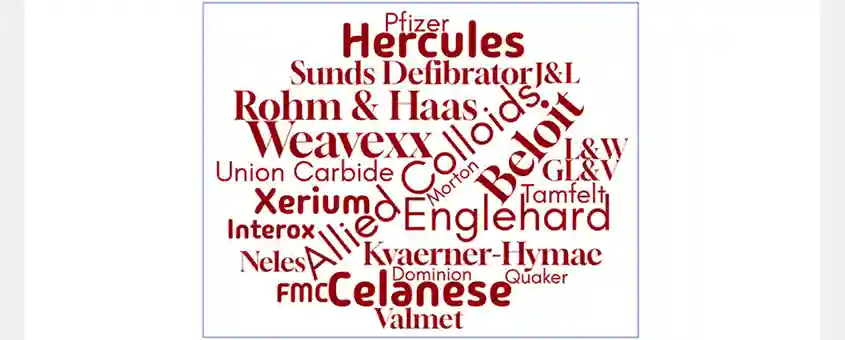
In the same nostalgic vein, this blog post is about some of the industry suppliers that went through mergers and acquisitions or went out of business in North America. Old-timers will recognize most of these names. Those of you newer to the industry may have noticed some of these names on older equipment. The list below is not comprehensive, but as a fun exercise I tried to think of one name corresponding to each letter of the alphabet, and succeeded in filling 23 out of 26 letters!
A is for Allied Colloids, a company supplying retention aids and water treatment chemicals. It was acquired by Ciba Specialty Chemicals in 1998, which was itself acquired by BASF in 2008.
B is for Beloit, which started manufacturing paper machines in Beloit, Wisconsin in 1862. It declared bankruptcy in 2000 and the assets were acquired by various companies, including Valmet and GL&V. Many original Beloit machines are still running today.
C is for Celanese, which acquired Virginia Chemicals in 1981, supplying hydrosulphite bleach. This business then went through three more ownership changes: Hoechst-Celanese, Clariant and Chemtrade Logistics.
D is for Dominion Engineering Works, based in Montreal, which was acquired by GE Canada in 1962. In 1984, the paper machine segment was sold to Valmet and the company operated as Valmet-Dominion until 1991, when it dropped the Dominion name.
E is for Englehard, which sold clay for paper products. It was acquired by BASF in 2006.
F is for FMC. Originally called the Bean Spray Pump Company, it changed its name to Food Machinery Corporation in 1928 after acquiring two other companies. It operated several hydrogen peroxide plants that supplied the pulp and paper industry. The peroxide business was sold to One Equity Partners in 2014, then acquired by Evonik in 2018.
G is for GL&V (Groupe Laperrière & Verreault), founded in 1975 to provide a variety of equipment, spare parts, upgrades and other services to the industry; it was acquired by Valmet in 2019.
H is for Hercules, who supplied wet-end and water-treatment chemicals; it was acquired by Ashland in 2008 and then Solenis in 2014.
I is for Interox, a hydrogen peroxide supplier that started up in 1970 as a joint venture between Solvay and Laporte, but Solvay took full ownership in 1992 and currently operates the peroxide business as Solvay Interox.
J is for J&L Fiber Services. It produced refiner plates in Wisconsin and was acquired by Valmet in 2019.
K is for Kvaerner-Hymac. Hymac, a Canadian-based manufacturer of refiners for TMP, was acquired by the Norwegian company Kvaerner and operated as Kvaerner-Hymac. It was acquired by Andritz in 1997.
L is for L&W (Lorentzen & Wettre), which sold laboratory and process control instrumentation. It was acquired by ABB in 2011.
M is for Morton International, which sold Borol systems to manufacture hydrosulphite bleach onsite. It was acquired by Rohm & Haas in 1999 (see R).
N is for Neles Automation, which began life as Neles Oy in 1956 making industrial valves. By the late 1990’s Neles Automation was part of Metso’s flow-control / automation division. In the restructuring of Metso (see V for Valmet) in 2000, it was spun off as Neles Corporation, but then it was acquired by Valmet in 2022.
P is for Pfizer, which developed the technology to manufacture and use precipitated calcium carbonate in paper. It was spun off as Specialty Minerals Inc. in 1992.
Q is for Quaker Chemical, which had a small amount of business in softeners, debonders and lotions for tissue/towel manufacturing. In 2000, Quaker sold its U.S. pulp and paper chemical business to Hercules (see H).
R is for Rohm & Haas (see M). The borohydride business was acquired by Dow in 2009, which sold it Vertellus Specialty Materials in 2015. Following the Chapter 11 bankruptcy of Vertellus in 2016, the borohydride business survived and was re-branded as Ascensus Specialties.
S is for Sunds Defibrator, which was a merger formed in 1979 between Swedish companies Defibrator and Sunds, specializing in TMP refiners and supporting equipment. It was acquired by Valmet in 1999.
T is for Tamfelt. It was a Finnish company based in Tampere making paper machine felts. It was acquired by Metso in 2009.
U is for Union Carbide. While not a major supplier to pulp and paper, it sold wet-strength agents for tissue and towels. The company was acquired by Dow in 2001.
V is for Valmet – yes, it still operates today, but in 1999 it merged with another Finnish company, Rauma-Repola, to become Metso. In 2013, the Valmet brand was spun off again.
W is for Weavexx, which was a brand of paper machine clothing established in 1992 after a merger between Niagara-Lockport and Huyck. It was owned by Xerium (see X).
X is for Xerium (see W), which made fabrics and rolls. It was acquired by Andritz in 2018.
All these transformations are like a food chain: big companies swallow up little companies, then there’s a digestion process. Businesses are modified, broken up or absorbed, but sometimes are spat out again. If you have any comments, feel free to contact me at
 Martin Fairbank, Ph.D. Martin Fairbank has worked in the forest products industry for over 35 years, including many years for a pulp and paper producer and two years with Natural Resources Canada. With a Ph.D. in chemistry and experience in process improvement, product development, energy management and lean manufacturing, Martin currently works as an independent consultant, based in Montreal. He has also published Resolute Roots, a history of Resolute Forest Products and its predecessors over 200 years.
Martin Fairbank Consulting
Industry Experience
- Pulp and Paper Technology
- Biorefinery Development
- Government Subsidy Programs
Services
- Carbon Footprint Analysis
- Technical Writing
- Scientific Writing