


No expense was spared in converting two of its biggest graphic paper machines to packaging grades
“I started with a paper company; now I work for a packaging company,” Matti Lielahti, business unit head, Stora Enso, said about his employer at the Pulp and Beyond conference held in Helsinki in April.
Although he was talking about the company in general -- which has fixed its future on three sectors: consumer packaging (cartonboard, liquid packaging); integrated packaging containerboard); and biomaterials – his remarks were aimed specifically Stora Enso’s Oulu mill in northwestern Finland.
In the face of the new reality of today’s pulp and paper industry, the company, as with many others, realized it had to close, sell or convert most of its graphic papermaking operations. With a strong infrastructure and good logistics in place, not to mention a skilled workforce of 900, Oulu was a good candidate to be converted.
So began the company’s largest capital investment on record. The company recently completed Phase 2 of a massive Euro 1.7 billion (CDN$2.72 billion) project that converted the mill’s two relatively modern paper machines to produce containerboard (kraft liner on BM 7) and cartonboard (FBB and CKB on BM 6). BM 6 had started up as PM 6 in early 1995 while PM 7 had started up in April 1997.
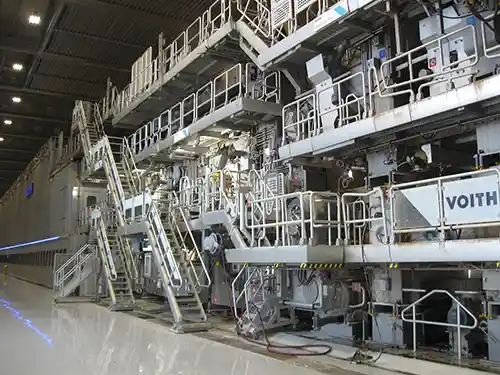 Oulu’s BM 6 was converted to produce cartonboard for packaging markets.
Image: Stora Enso
The BM 7 project was done first between 2019 and 2021. It can now produce 450,000 t/y of kraft liner. Upgrades to the kraft pulp operations were also done at this time.
The BM 6 project began in 2022 and wrapped up in 2025. At full capacity. It will make 750,000 t/y of consumer board grades. The BM 6 project is still in the ramp-up phase with full production expected to be achieved in 2027.
A press visit was organized during Pulp and Beyond and was hosted by Kati Ekman, head of product line, FBB. She echoed Lielahti’s remarks about Stora Enso’s focus on renewable packaging. “We see long-term market growth in consumer board, especially virgin fiber brands.”
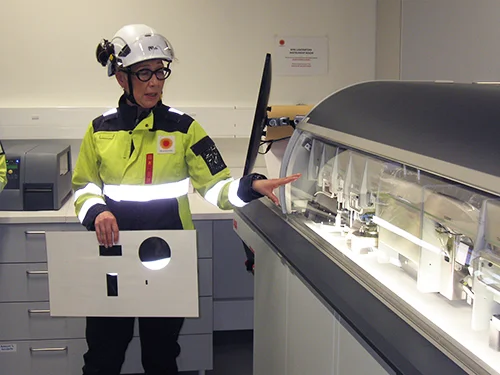 Kati Ekman présente les grades de carton plat développés sur la BM 6 du site d’Oulu. Image : Stora Enso
IN AND AROUND THE MILL
To help prepare for the project, Stora Enso purchased the assets of Junnikala, which included four sawmills, all located within a 100-km radius of Oulu. This secured a cost-efficient wood supply for the mill and increased wood procurement by 1.7 million m3 annually. At full production, the mill will use about 3.5 million m3/y of wood.
The mill now sources about 25% of its fiber needs in the form of chips from these sawmills. Most of its fiber is sourced from northern Finland. Mostly softwood, the mill does use some birch as well as some purchased eucalyptus pulp.
Although most of its pulp production (kraft, BCTMP) is integrated, it does sell about 160,000 t/y of unbleached kraft pulp.
The BCTMP mill was rebuilt almost entirely by Valmet. This is used in the middle layer of the board. It can produce 550,000 t/y. Valmet also did work on the evaporation system as well as a non-condensable gas collection system.
Although called a conversion, BM 6 is virtually a new machine. Only some parts of the dryer and foundation are left from the original PM 6. Voith did the rebuilt which included three headboxes, one for each ply. There are three separate shoe presses. There is a surface sizer for each side of the web.
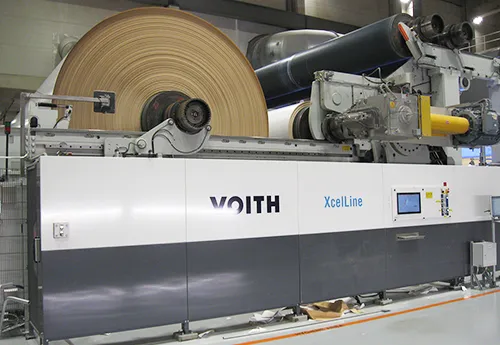 The dry end of BM 6 is part of the extensive conversion project at the Oulu site toward packaging grades. Image: Stora Enso
Four online coating stations were installed; three for the print ply and one for the back ply. Trim width is 8.33 m and the basis weight range is 195-415 g/m2.
An Autoline paper tester takes 17 measurements from each reel A new sheeting plant was also built. It is also in the ramp-up phase. Not all production is sheeted; some is sold in rolls. It depends on the customer.
Pesmel built a 40,000-t capacity, high-bay automated warehouse. Operations are controlled by the port operator Herman Andersson Oy, a leading logistics company based in northern Finland. The port also saw some major upgrades during Phase I (2019-2002). Ekman called the port on the Gulf of Bothnia a “major advantage” for the mill, especially as the bulk of production is shipped by sea. The U.S. and Europe are two of the mill’s most important markets.
LOOKING AFTER THE ENVIRONMENT
The mill is in an urban setting, located only about 1 km from Oulu, a city of just over 200,000 people, which just happens to be the European Capital of Culture for 2026. The population is quick to notice when something is off. Therefore, Ekman said, “We must be very conscious of our operations. It pushes us to do better.”
To this end, some Euro 40 million was invested in environmentally-related projects. Fossil CO2 emissions have dropped 99% compared with 2018 levels. No process residuals are shipped to landfill.
PRODUCTS FOR THE FUTURE
Obviously, before embarking on such a huge investment, Stora Enso had to do its homework. In his talk in Helsinki, Lielahti said, “We worked hard on our customers before startup and it paid off.”
Ekman added,” We did the project for product innovation to drive competitiveness and expand addressable markets. We designed the board machine to be able to adapt to future markets: 10+ years ahead.”
Oulu’s FBB line features two products: Perfuma Nova and Perfuma Lumi.
Ekman refers to Nova as the lightweight superstar. It is designed mostly for food end uses, especially frozen and chilled food. However, it also has good applications in dry food and health care.
The secret to Nova’s light weight is what Ekman calls its “miracle” layer. This middle layer is composed of BCTMP and microfibrillated cellulose that is produced by Stora Enso’s patented FiberLightTec™ technology. This gives the middle layer strength and bulk but at a much lighter weight than conventional middle plies. The other layers are chemical pulp.
Lumi has a similar fiber structure but both sides are white and coated. It has excellent printability so it is quite suited to beauty as well as health care products.
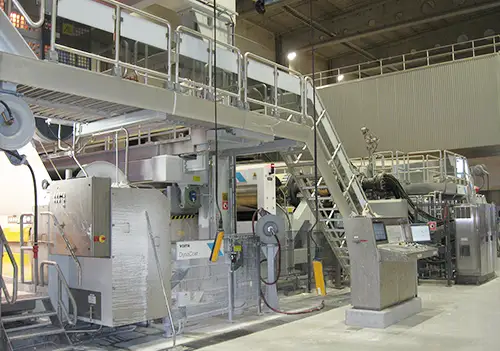 Le carton produit à Oulu peut être couché sur une ou deux faces selon les applications visées. Image : Stora Enso
Coated kraft board (CKB) is Stora Enso’s own brand. It is made for food, beverage as well as multi-pack applications. It is coated one side.
It can also be used in folding cartons such as frozen and other food packaging. It can also be printed on the unbleached side if desired.
As noted, full capacity of BM 6 is expected in 2027 which coincides nicely with the 90th anniversary of the opening of the first pulp mill at Oulu. Thus far, Ekman can say proudly, the BM 6 project came in on schedule, on budget and has met expectations.
Stora Enso operates a major integrated complex in Oulu producing paperboard (FBB and CKB), kraftliner, as well as kraft pulp and BCTMP, primarily serving the food packaging, beverage and consumer goods markets.

Graeme Rodden has covered the pulp and paper industry for more than 40 years, including serving as editor of several well-known paper industry magazines.