


After cracks rendered a suction press roll unfit for service, Domtar located a used roll in the United States that could be adapted to the machine. Canmec completed the modifications in four weeks, with technical support from Andritz and the involvement of the mill's teams, allowing paper machine No. 5 to resume production overnight on July 1–2.
Canmec Adapts a Used Roll in Four Weeks to Restart Domtar's Paper Machine No. 5
Canmec adapted a used suction press roll in four weeks to enable the restart of Domtar's paper machine No. 5 at Domtar's Dolbeau-Mistassini mill in Quebec. The work allowed the mill to resume production approximately six weeks after the shutdown, rather than wait several more months for delivery of a new roll.
The problem was discovered in late May while the Dolbeau teams were carrying out planned maintenance on paper machine No. 5. An inspection of a suction press roll revealed concerning cracks.
The roll was removed for a more detailed inspection, which showed that the damage also extended to the roll's internal surfaces, making it unsafe for continued operation.
The failure brought paper machine No. 5, the mill's primary production machine, to a standstill. The machine produces book paper, newsprint and approximately 100 different paper grades.
A new roll had fortunately been ordered before the cracks were discovered. However, the manufacturing lead time associated with this type of custom equipment meant the mill could remain shut down for several months.
Three Scenarios to Reduce the Duration of the Shutdown
Domtar's teams worked simultaneously on three possible scenarios: repair the damaged roll, accelerate delivery of the new roll, or identify an existing roll that could be modified for the machine.
The first option was quickly ruled out as unsafe. The roll's metallurgy and the extent of the damage did not allow for a repair that could be considered safe.
Domtar also evaluated whether production of the new roll already on order could be expedited. Even with compressed manufacturing and delivery schedules, several additional weeks would still have been required before installation and restart.
That left a third possibility: locating a used roll with specifications close enough to the roll used at Dolbeau to make modification feasible.
This approach presented its own challenges. Rolls used on paper machines are often engineered around the specific design and operating requirements of each installation. Finding a roll with similar dimensions does not necessarily mean it can be installed directly on another machine.
The search extended internationally. Potential rolls in Brazil and Austria were examined before a suitable used roll was ultimately located in the United States.
Domtar invested several hundred thousand dollars to acquire the roll and reduce the duration of the outage.
Compatible Diameter, but a Shorter Shell
The U.S. roll offered one critical advantage: its diameter matched the requirements of paper machine No. 5. However, its shell was shorter than that of the original roll, and its roll heads also had to be modified.
The roll was transported to Canmec's facility in La Baie, Quebec, where the teams began the inspection and adaptation work.
The solution initially proposed by Domtar was reviewed with Canmec's engineering team to ensure that the modified roll would meet the machine's mechanical and operating requirements for temporary service.
Engineering work included 3D modeling and finite element analysis to validate the modified roll's integration into the existing machine.
The work involved significantly more than shortening or adapting a single component. Several elements had to be modified to allow the roll to fit the machine and operate safely under the loads imposed by the press section.
"It was far from certain that we would even be able to install a modified roll that was not the machine's original roll. There was no guarantee that it would work," said Jean-Michel Simard, manager of Domtar's Dolbeau-Mistassini mill.
Four Weeks of Engineering and Fabrication at Canmec
Canmec carried out the work at its La Baie facility. The project, which began in early June, involved four managers and engineers as well as approximately 10 shop-floor employees.
Having the engineering, fabrication and skilled trades required for the project within Canmec helped maintain close coordination between the design of the modifications and their implementation on the shop floor.
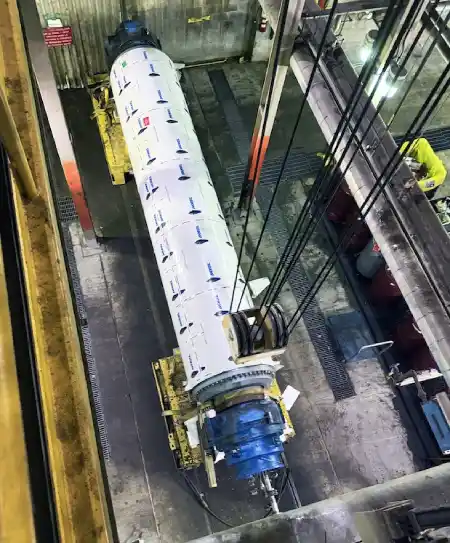
Canmec and Domtar teams also maintained continuous communication throughout the project, with progress updates approximately every three days.
For Domtar, the challenge went far beyond replacing a component. Every additional week of downtime meant another week without production from the mill's principal paper machine.
"We are extremely proud of this project. Our entire team contributed. During one meeting with Domtar, one of their comments stayed with me: for Canmec, this project was a priority; for Domtar, it was vital. That really captures the importance of the work," said Frédéric Pellerin, Canmec's Director of Operations, Pulp and Paper.
Andritz Supports Restart Preparations
Andritz, a Domtar supplier and Canmec partner in the pulp and paper sector, provided technical support for the project and supported the teams as they prepared for the restart.
While Canmec worked on the roll, the Dolbeau teams completed as much preparatory work as possible on the machine. The objective was to minimize the time required between the arrival of the modified roll and the machine restart.
The search for a solution also extended beyond the Dolbeau mill. Teams at other Domtar facilities contributed their expertise and contacts and networks to help identify and evaluate potential replacement options.
That coordination proved particularly important when the modified roll arrived at the mill.
Installed in 12 Hours, Producing Paper on the First Attempt
After four weeks of work at Canmec, the roll arrived at Dolbeau on July 1.
Thanks to the preparatory work completed while the roll was being modified, engineering, maintenance and operations teams were able to install it and put it into service in approximately 12 hours.
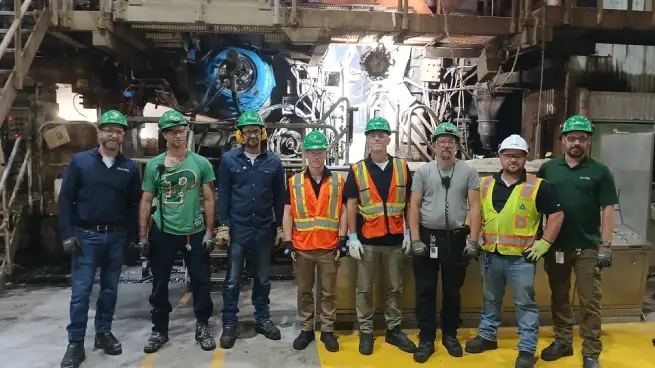 From left to right: Jean-Michel Simard, Mill Manager; Robin Marcil, Paper Machine No. 5 Operator; Youri Simard-Boulianne, Engineering Superintendent; Jean-Benoit Gauthier, Technical Sales Coordinator (Canmec); Frédéric Pellerin, Director of Operations (Canmec); Junior Trembaly, Paper Machine No. 5 Technical Coordinator; Jean-Denis Gagnon, Representative (Andritz); Dave Rousseau, Maintenance Manager.
Paper machine No. 5 was restarted overnight on July 1–2. After operators adjusted the press loading, the machine produced paper on the first attempt.
"At first, we had some uncertainty about how the modified roll would perform. We adjusted the presses and, on the very first attempt, it worked," said Robin Marcil, paper machine No. 5 operator at Domtar's Dolbeau mill.
The restart ended approximately six weeks of downtime and allowed the mill to resume operations without waiting for installation of the new roll.
The mill employs 177 people, about 40% of whom had been temporarily laid off during the shutdown. The machine restart allowed those employees to return to work.
A Return to Service Built on Complementary Expertise
The return to service relied on several areas of expertise: Canmec for engineering and mechanical modifications to the roll, Andritz for technical support, and Domtar for its knowledge of the machine, installation preparation and operational adjustments.
For Youri Simard-Boulianne, Engineering Superintendent at the Dolbeau mill, the experience demonstrated the importance of pursuing multiple options when a critical component cannot be replaced quickly.
"The solution came together like a tower, with everyone adding their own brick," he said.
Beyond the response to an urgent equipment failure, the project highlights a broader issue facing many North American pulp and paper mills: how to maintain or rapidly restore production when critical equipment depends on specialized components with long replacement lead times.
In this case, the solution was not to find a perfectly interchangeable replacement. It was to identify a roll with sufficient compatibility for engineering and fabrication to bridge the remaining differences.
 The Domtar mill in Dolbeau-Mistassini produces a diversified range of printing and publishing papers, including book paper, newsprint, inserts, and several high-brightness, lightweight grades.
Commitment to Quality and Partnership

Canmec’s performance is built on reliable products, expert personnel, and transparent communication. This approach fosters long-term partnerships with mills, supporting sustained productivity.
For immediate assistance, you can contact:
|
Frédéric Pellerin, Eng., MBA |
|
|
Jean-Benoit Gauthier |
|
 418-543-9151 Poste: 309 / 581-306-1716
 3453, chemin des Chutes, Saguenay Qc G7B 3N8 Canada