

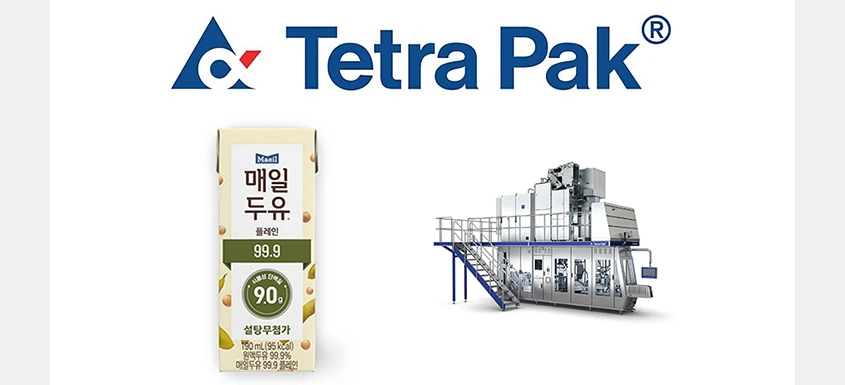
Tetra Pak has expanded its paper-based barrier technology to high-speed Tetra Pak® A3/Speed filling lines in Asia, with South Korea’s Maeil Dairies becoming the first producer globally to adopt the solution for soy milk packaging.
The innovation replaces the aluminium foil layer in aseptic cartons while maintaining food protection and shelf life. Maeil’s Tetra Brik® Aseptic 200 Slim carton for Soy Milk 99.9 reaches 87% renewable content using sugarcane-based polymers and delivers a 26% reduction in carbon footprint, as verified by the Carbon Trust.
High-speed compatibility enables scale
Maeil’s implementation marks the first use of the paper-based barrier on Tetra Pak® A3/Speed lines, which can produce up to 24,000 packages per hour with low operational costs. Existing A3/Speed machines can be upgraded with a high-frequency induction-heating sealing system, allowing producers to adopt the new material without significant capital investment.
“Scaling sustainable packaging must align with operational efficiency,” said Tatiana Liceti, Executive Vice President, Packaging Solutions at Tetra Pak. “Extending the paper-based barrier to A3/Speed lines enables producers to adopt renewable, low-carbon packaging while maintaining food safety and cost competitiveness.”
First application in plant-based beverages
The launch represents the first application of Tetra Pak’s paper-based barrier in the plant-based beverages category. Maeil Dairies, a key player in low-sugar soy milk, views the move as a continuation of its sustainability and product development efforts.
The simplified two-layer carton structure, compared with traditional three-layer designs, improves recyclability by maximizing paper fibre recovery and supporting circular packaging systems. The development underscores how renewable materials can be scaled for industrial use without compromising performance.
Tetra Pak is a global provider of food processing and packaging solutions, serving customers in more than 160 countries. The company focuses on developing safe, efficient, and increasingly renewable packaging systems that support food protection, operational performance, and sustainability.
Source: Tetra Pak