


In Quebec, Domtar is facing mounting political, union, and Indigenous scrutiny over two separate but increasingly intertwined controversies: the authorization of logging operations in a sensitive area on the Côte-Nord and the discreet transfer of its hydroelectric facilities in the Saguenay–Lac-Saint-Jean region.
While distinct in nature, the two cases have converged to reignite criticism over natural resource governance, transparency in public decision-making, and respect for local and Indigenous communities.
A forestry permit overturned in minutes
On the Côte-Nord, the pulp and paper producer obtained authorization last fall to carry out forestry operations in a sensitive area, despite an initial refusal from officials at Quebec’s Ministry of Natural Resources and Forests (MRNF). According to reporting by La Presse, the decision was reversed following a phone call lasting less than twenty minutes between Domtar executives and a senior ministry official, who cited the prevailing “economic context.”
The targeted area consists largely of untouched forest and lies near Innu heritage sites as well as within the range of protected caribou herds. Ministry officials had previously noted that mandatory consultation requirements with the Innu community of Pessamit had not been met prior to the application.
Although the Quebec government later suspended the authorization, the move has widely been viewed as symbolic. Forest road construction had already begun, and logging was not scheduled to start in the immediate term. For Innu representatives, trust in the consultation process has been deeply undermined.
Saguenay: hydropower transfer fuels tensions
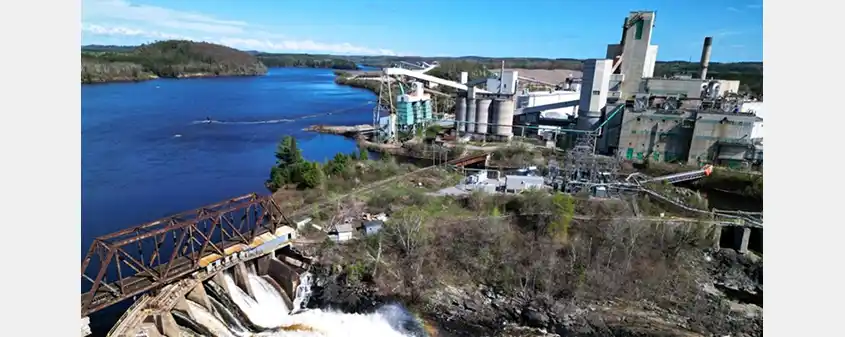
At the same time, Domtar has come under fire in the Saguenay–Lac-Saint-Jean region for transferring its hydroelectric facilities on the Shipshaw River to a limited partnership linked to its Indonesian shareholder, without prior notice to municipal authorities. Enabled by recent changes to Quebec’s energy legislation, the transaction has raised concerns about a potential sale of electricity—or even the assets themselves.
The City of Saguenay unanimously adopted a resolution denouncing what it described as a “behind-the-scenes” transfer and invoked its right of pre-emption to protect regional energy benefits. Municipal leaders stress that access to these energy blocks has historically been tied to maintaining industrial activity and jobs in the region.
Unions and regional elected officials fear that hydropower revenues could be redirected to projects elsewhere, while the Kénogami paper mill remains vulnerable and uncertainty continues to weigh heavily on workers.
Political pressure and calls for transparency
In Ottawa, the Bloc Québécois has gone so far as to summon Domtar’s owner before the House of Commons Standing Committee on Natural Resources to explain the company’s intentions in Canada. In Quebec City, opposition parties are calling for full transparency regarding the influence exerted by the forestry industry on certain ministerial decisions.
Taken together, these developments highlight growing tensions between economic imperatives, sustainable resource management, and social acceptability. For Domtar, they raise a central question: the legitimacy of decisions made when consultation and transparency rules appear—at least in the eyes of many stakeholders—to have been bypassed.